
PLA+ filamentTougher PLA · 1.75 mm
PLA+ keeps the printability of PLA and trades a little tensile strength for impact toughness: 6.0 kJ/m² notched against 4.5 for PLA Basic, and 35 kJ/m² unnotched against 30. Order it when the part has to survive being dropped or knocked, not only measured.
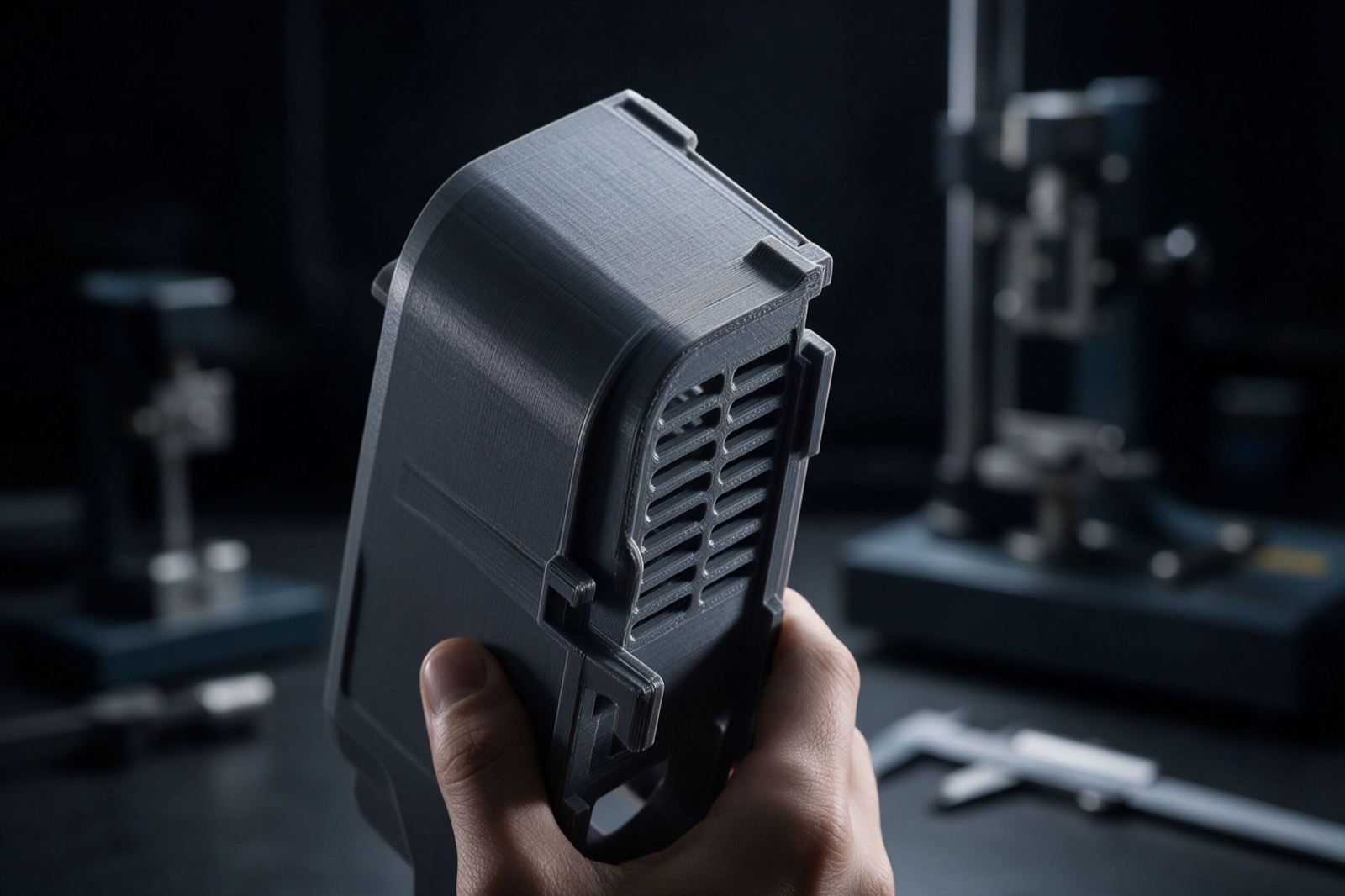
PLA+, measured
not described.
PLA+ — easy to print, higher toughness, less brittle.
- 01 Where PLA Basic cracks, PLA+ holds. Notched impact strength rises from 4.5 to 6.0 kJ/m² and unnotched from 30 to 35 kJ/m² — the difference between a housing that survives a bench drop and one that splits along a layer line.
- 02 The same machine, the same window. A 5–9 g/10 min melt flow index and 58 °C Vicat mean the temperatures and speeds you already run for PLA Basic carry over. No enclosure, no new profile to learn.
- 03 The trade is strength, not surface. Tensile strength is 45 MPa against 50 MPa for PLA Basic, and flexural modulus 2 800 against 2 950 MPa. The part gives a little more before it breaks, and detail and surface finish stay at PLA level.
PLA+ filament — measured values.
Figures are reported against the ASTM method stated beside each property, on specimens printed in XY orientation unless noted. Batch test reports are available per lot.
| Density | 1.20 ± 0.1 g/cm³ASTM D792, 23 °C |
| Vicat softening temperature | 58 ± 3 °CASTM D1525, 5 kg, 50 °C/h |
| Heat deflection temperature | 58 ± 3 °CASTM D648, 0.45 MPa |
| Melting temperature | 155 ± 5 °CASTM D7426, 10 °C/min |
| Melt flow index | 5–9 g/10 minASTM D1238, 210 °C / 2.16 kg |
| Tensile strength, XY | 45 ± 5 MPaASTM D638, 20 mm/min |
| Elongation at break, XY | 10 ± 2 %ASTM D638, 20 mm/min |
| Flexural modulus, XY | 2 800 ± 50 MPaASTM D790, 5 mm/min |
| Flexural strength, XY | 75 ± 5 MPaASTM D790, 5 mm/min |
| Impact strength, XY | 35 ± 3 kJ/m²ASTM D6110, 23 °C |
| Notched impact strength | 6.0 ± 0.5 kJ/m²ASTM D6110, 23 °C |
| Young's modulus, XY | 650 ± 30 MPaASTM D638, 20 mm/min |
Compare this grade against the rest of the range in the filament comparison table.
A starting point for your slicer.
These are the settings we run when the grade is qualified on our own bench. Treat them as a starting window, then tune to your machine — and confirm against the lot TDS before a production run.
| Nozzle temperature | 200–220 °C |
| Bed temperature | 50–60 °C |
| Part cooling | 80–100 % |
| Print speed | 50–120 mm/s |
| Drying before use | 45 °C for 4 h if the spool has been open for months |
| Enclosure | Not required |
| Bed adhesion | PEI sheet or glass with glue stick |
| Retraction | Standard, direct drive or Bowden |
Where buyers use PLA+.
Enclosures and housings
Covers and casings that get opened, dropped or knocked in service — the impact numbers are the reason to pick this grade.
Toys, props and display pieces
Handled objects that need PLA surface quality but would crack in PLA Basic after a few drops.
Functional prototypes
Parts taken off the printer and straight into a user trial, before a design is frozen.
Light-duty brackets and mounts
Where a PLA part was breaking at a layer line and a tougher grade is the cheapest fix.
Colour availability, confirmed per order.
PLA+ is supplied from our PLA shade library. The codes currently stocked in PLA+ are confirmed per order — send the shade reference or the code list and our sales team will come back with availability.
What buyers ask about PLA+.
Is PLA+ stronger than PLA Basic?
It is tougher, not stronger. Tensile strength is lower (45 MPa against 50 MPa) and flexural modulus slightly lower, but notched impact strength is higher at 6.0 kJ/m². Choose by failure mode: if the part breaks from a hit, PLA+; if it deflects under steady load, PLA Basic.
Do I need to change my PLA settings for PLA+?
No. The processing window is the same — 200–220 °C nozzle, 50–60 °C bed, 50–120 mm/s. Most slicers ship a generic PLA profile that works for both; adjust flow by a couple of percent if your prints come out slightly fuller.
Is PLA+ food-safe or biodegradable?
The base resin is PLA, but grade additives and colourants change the picture, and printed parts are not food-contact approved by default. Ask for the material declaration of the specific colour before specifying a food-adjacent application.
What spool sizes and order quantities are available?
1 kg spools as standard and 3 kg spools for production runs, with OEM packing and private-label cartons. Minimum order quantity depends on grade and colour — send your list and we will confirm.
Send the shade, the grade
and the spool weight.
We come back with the matching grade, a colour trial plan and a packing proposal — and quote wholesale and OEM volumes directly, without a trading layer in between. No guessed specifications.
Request a Quote
Tell us the machine, material and quantity you need.
- [email protected]
- +8616619919553
- Office
- 14th Floor, Block A, Building 2, University Science Park, No. 11 Changchun Road, High-Tech District, Zhengzhou, Henan, China
- Factory
- Hechang Town, Heshan City, Jiangmen City, Guangdong Province, China